

Loading...
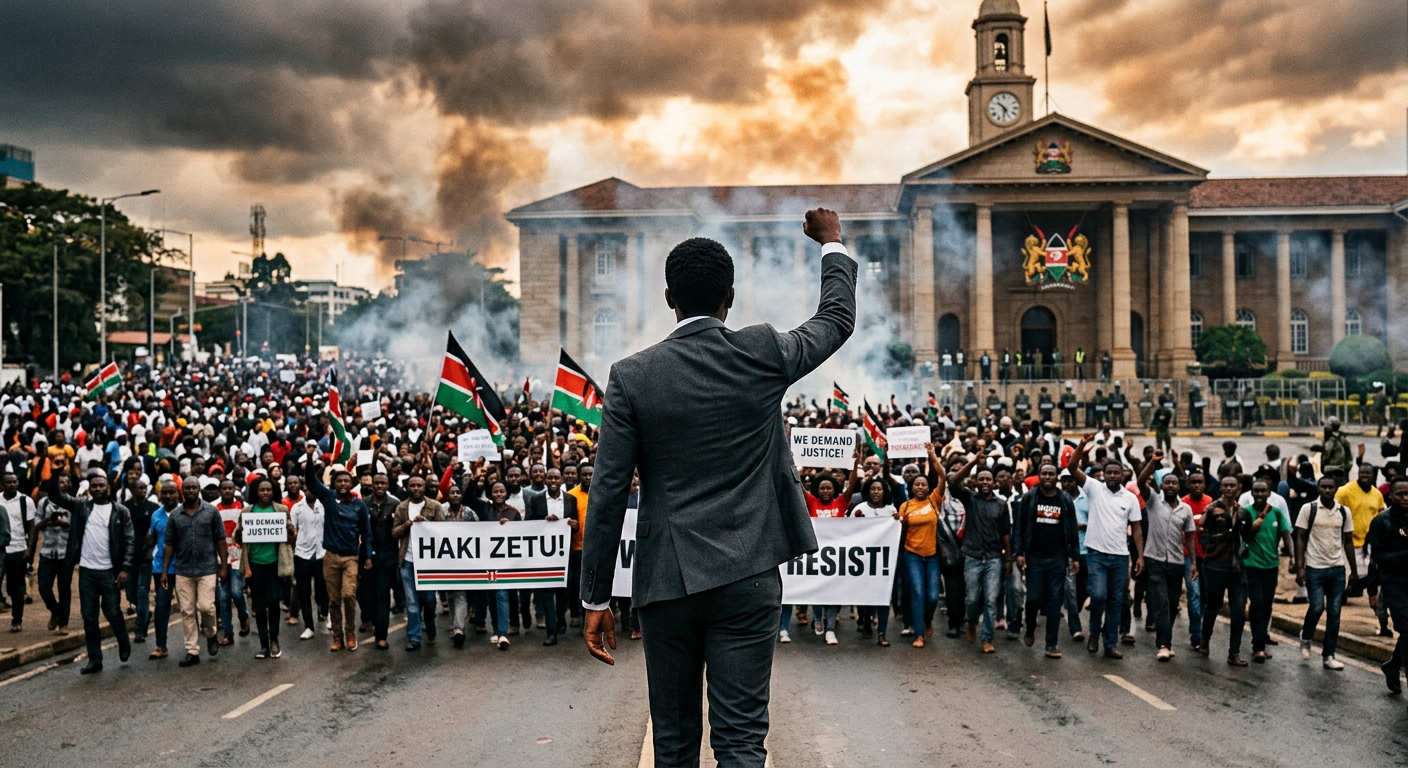
On June 25, 2024, a young man in a full suit stood his ground outside Parliament Buildings in Nairobi as tear gas canisters hissed across the grounds. Kasmuel McOure — he had not come to fight. He had come, dressed like the future he was demanding, to say that Kenya's young people were done being ignored.
That afternoon, protesters breached Parliament. Police opened fire. Somewhere between twenty and sixty people died in the days that followed. The Finance Bill, a proposed set of taxes on bread, diapers, sanitary towels, and digital services, was withdrawn. President William Ruto dissolved his entire Cabinet, the first such action in nearly two decades. It felt, briefly, like a revolution.
Kasmuel became a face of that moment. He was photographed, shared a million times, celebrated. Then, like so many young Kenyans who dared to be visible before him, he was watched. Approached. Absorbed.
Kenya has seen this before. Not once, not twice, but across generations. A young person rises through dissent, gains visibility, and is either co-opted into the system or crushed by it. The faces change. The playbook does not.
It goes like this: spark or join a movement against the status quo, amplify your voice until someone notices, receive an offer of a position, a platform, or a quiet sum of money, and either accept or face the consequences. Watch the next wave emerge, feeling betrayed, ready to repeat the cycle.
Understanding why this keeps happening requires going back further than 2024. The system is not broken. For those who built it, it is working exactly as intended.
Long before TikTok coordinates were mapped to protest routes, young Kenyans were using visibility as a political ladder, sometimes against the establishment, sometimes alongside it.
James Orengo was elected to Parliament in his late twenties and became one of the loudest critics of President Daniel arap Moi's one-party rule. He defended political detainees, condemned authoritarianism, and was at the forefront of the Saba Saba protests that pushed Kenya toward multiparty democracy in the early 1990s. He survived harassment and built a decades-long career as an opposition stalwart. His early radicalism became, in time, a senior government appointment.
Raila Odinga's origin story is starker. Accused of involvement in the failed 1982 coup attempt against Moi, he spent years in detention without trial. He emerged not broken but transformed, a liberation figure whose protest credentials powered one of Kenya's most enduring political careers. Critics would later argue that the same tactics he once used sincerely became, over time, instruments of negotiation.
Then there is the case that most unsettles the "youth as innocent opposition" narrative. In 1992, a 25-year-old William Ruto was a key organiser of Youth for KANU '92, a state-aligned youth wing created not to challenge power but to defend it. Led by Cyrus Jirongo, the group mobilised grassroots support and patronage networks to secure Moi's re-election in Kenya's first multiparty contest. Ruto gained national visibility and connections that launched everything that followed.
The point is not that these three men are the same. The point is that the entry mechanism, using youth energy to become visible and then attaching to power in some form, predates every generation that has since discovered it.
What made the June 2024 protests striking was precisely what they lacked. No single leader. No tribal fault lines. No party machinery pulling strings behind the scenes. Coordinated across 44 of Kenya's 47 counties through X Spaces, TikTok, and WhatsApp groups, the movement was something the political establishment genuinely did not know how to handle.
Kevin Monari, known online as Osama Otero, hosted an X Space that drew 1.2 million listeners. On July 5, President Ruto himself joined one such Space, an extraordinary moment in which the head of state was briefly a participant in a conversation he did not control. Morara Kebaso became a recognisable voice. Hanifa Adan channelled the movement's energy into sustained demands for accountability. None of them were leaders in any formal sense. That was the point.
The demands were coherent: withdraw the Finance Bill, stop the abductions of activists, address corruption and youth unemployment. The movement forced the largest single act of executive accountability in years. A cabinet dissolution that would have been unthinkable months earlier became reality.
The machinery then turned its attention to the protesters.
There is a phrase that circulates quietly among Kenyan youth activists. It is offered sometimes as encouragement, sometimes as a warning. You don't know who is watching. Just do your best, you might be the next.
The next what is left deliberately vague. The next appointed official. The next party functionary. The next face on a campaign poster. In a political system where independent electoral entry requires resources and networks that most young Kenyans simply do not have, visibility itself becomes currency. The loudest voices become targets for acquisition.
Kasmuel McOure met with both Ruto and Raila Odinga after the protests. He joined the Orange Democratic Movement in late 2024. By February 2026, at anti-femicide marches, crowds were chanting "Enda home" at him. The man in the suit had become, in many people's eyes, another cautionary tale.
Osama Otero was labelled a sell-out after his role in facilitating the presidential X Space. Morara Kebaso eventually stepped back from active politics, citing safety concerns and public scrutiny. Those who were not co-opted often found themselves facing something worse. The Kitengela Three, activists abducted in August 2024, were among dozens documented by Amnesty International as victims of state intimidation.
A friend once put it plainly: political elites treat youth as a "disabled" group, struggling, noisy, and manageable. The loudest ones get "cured" via appointments. The rest get tired and go home. A new wave rises, certain that this time will be different. The system does not need to defeat youth movements. It only needs to wait them out, or buy them out, one voice at a time.
In mid-February 2026, something shifted. Rather than returning to the streets, a new wave of youth energy organised around a different kind of power: the ballot. The Niko Kadi, meaning "I have the voter card," campaign launched as a decentralised, youth-led voter registration drive ahead of the 2027 general elections.
By late March 2026, the campaign had registered over 250,000 new voters. A massive turnout at Moi International Sports Centre on March 17 signalled that this was not a social media moment but a physical mobilisation. Politicians, sensing the momentum, attempted to attach themselves to the slogan. The movement pushed back, deliberately keeping its structures flat and its messaging issue-based.
Whether Niko Kadi can hold its shape before 2027, whether it will be absorbed, fragmented, or simply outspent, remains genuinely unknown. It represents something worth watching: an attempt to convert protest energy into structural electoral power without waiting for an invitation from the gatekeepers.
The 2024 movement was principled at its roots. The demands for accountability, transparency, and an end to runaway taxation were real. The system it challenged, however, was not built to respond to principle. It was built to respond to pressure, and to neutralise that pressure as efficiently as possible.
Breaking the cycle requires more than a better protest. It requires lowering the financial barriers to electoral entry so that young people do not have to choose between visibility and co-option. It requires building non-partisan civic institutions, mentorship programmes, governance academies, and transparent appointment processes that offer pathways to leadership outside the patronage network. It requires an IEBC that functions as a genuine independent body. Above all, it requires a cultural shift, slow and difficult, from the logic of make noise until someone notices toward the logic of build institutions that outlast individuals.
The 2027 election will be the first major test of whether the Niko Kadi generation can translate a registration drive into actual seats, actual policy, actual power.
Kasmuel McOure is not a villain in this story. He is a young man who made himself visible in a system that rewards visibility, and then made the most available choice. That is the problem.
The Kenyan youth political playbook is not a conspiracy. It is not even, strictly speaking, a plan. It is a structure built over decades, one that turns energy into noise and noise into opportunity for some, while leaving the underlying conditions unchanged for everyone else.
The next wave is already forming. The question is whether they will read the playbook before it reads them.
Comments
Be respectful and constructive in your comments.