

Loading...
By Donald O. Magambo
Treasurer, HUSIKA \ Researcher in Digital Governance and Public Participation
Every Kenyan has, at one point or another, paid the price of corruption. It is felt when a patient finds an empty pharmacy in a public hospital because medicine funds were stolen. It is seen in roads that develop potholes months after construction because contracts were inflated and standards ignored. It is experienced by unemployed graduates who watch opportunities go to the well-connected instead of the qualified. Corruption is not an abstract political issue discussed in boardrooms and courtrooms—it is a daily burden that affects millions of ordinary citizens.
For decades, Kenya has declared war on corruption. Successive governments have promised to eradicate it, new laws have been enacted, oversight institutions have been established, and countless investigations have been launched. Yet corruption continues to dominate headlines and erode public confidence in government. The question is no longer whether Kenya has anti-corruption laws. It is whether the country has the collective will to enforce them fairly and consistently.
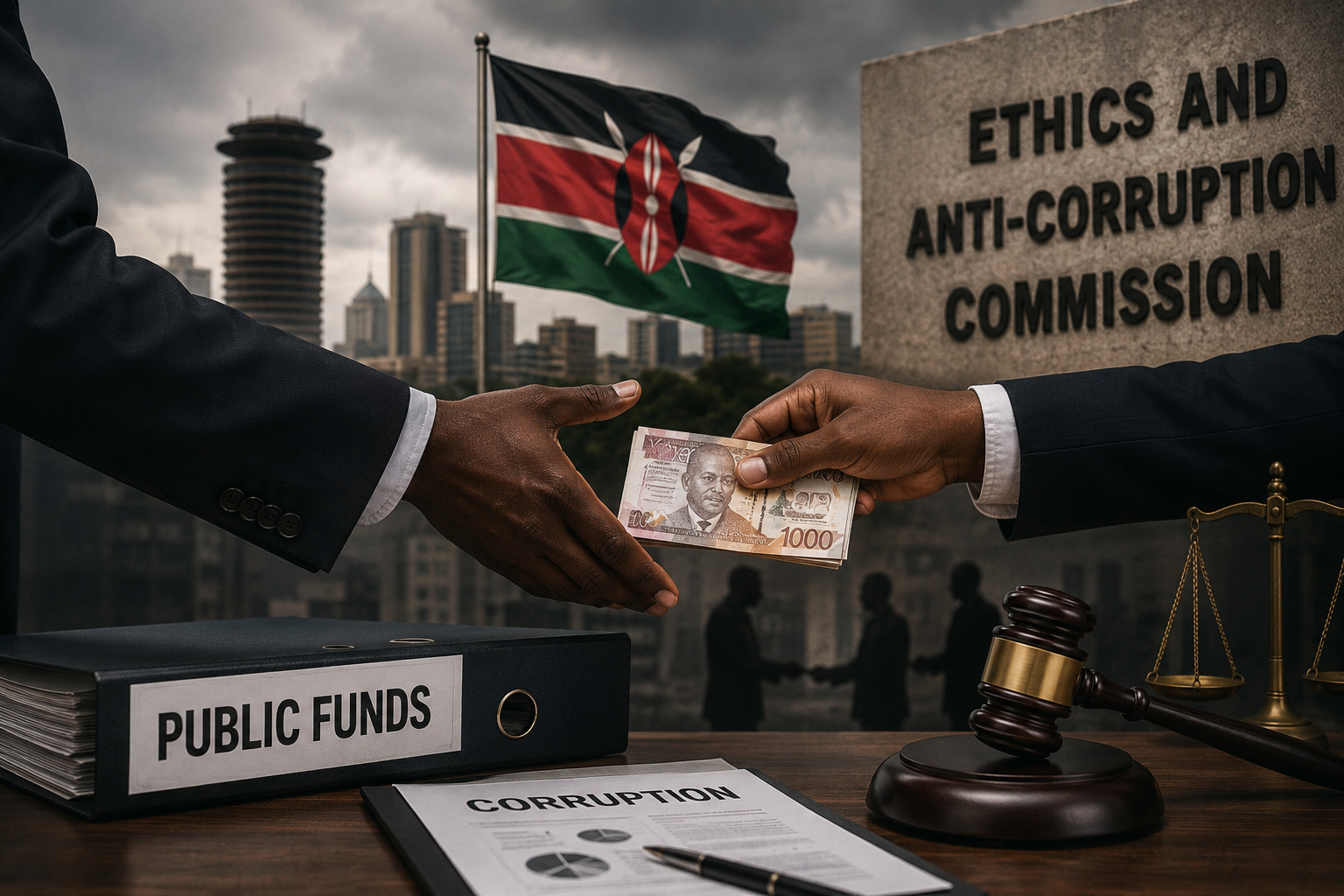
There is no denying that Kenya has made important strides. The Constitution of Kenya 2010 established integrity, transparency, accountability, and the rule of law as fundamental national values. Institutions such as the Ethics and Anti-Corruption Commission (EACC), the Office of the Auditor-General, the Office of the Director of Public Prosecutions (ODPP), the Directorate of Criminal Investigations (DCI), and the Controller of Budget have strengthened oversight of public resources. Digital government services, including online tax payments, procurement systems, and business registration platforms, have also reduced opportunities for petty corruption by limiting unnecessary human interaction.
Equally encouraging is the growing courage of ordinary Kenyans. Investigative journalists continue to expose questionable deals despite immense pressure. Civil society organizations demand greater transparency, while citizens increasingly use social media to hold leaders accountable. Public awareness has grown, and more Kenyans now understand that corruption is not a victimless crime—it directly affects the quality of education, healthcare, infrastructure, security, and employment opportunities.
However, these gains are overshadowed by persistent challenges. Too often, high-profile corruption cases generate dramatic headlines only to disappear into years of legal delays. Investigations begin with great public interest but end without meaningful accountability. This has created a dangerous perception that justice in Kenya is selective—that ordinary citizens face the full force of the law while the powerful can evade consequences.
Another major concern is political interference. Anti-corruption agencies can only succeed if they are allowed to investigate and prosecute without fear or favour. When institutions are perceived to be influenced by political interests, public confidence quickly erodes. The fight against corruption must never be reduced to a political weapon used against opponents while allies are shielded from scrutiny. Justice must be impartial if it is to command public trust.
Public procurement remains one of the weakest links in Kenya's governance system. Every year, billions of shillings intended for development are lost through inflated contracts, ghost projects, and irregular tender awards. The result is stalled projects, poor-quality infrastructure, and wasted taxpayer resources. Every stolen shilling represents a classroom that was never built, a hospital that was never equipped, or a young person who never found employment because development funds disappeared.
The fight against corruption cannot be left to government agencies alone. Citizens have a crucial role to play by refusing to pay bribes, reporting corruption whenever it occurs, demanding accountability from elected leaders, and participating actively in governance. At the same time, stronger legal protections must be provided for whistle-blowers, whose courage often exposes wrongdoing at great personal risk.
Kenya also needs faster and more effective justice. Corruption cases should not linger in court for years while evidence weakens and public interest fades. Swift investigations, timely prosecutions, and proportionate penalties would send a powerful message that corruption is a high-risk crime with real consequences.
Most importantly, the country must cultivate a culture of integrity from an early age. Ethics should not be viewed merely as a legal obligation but as a moral responsibility. Schools, families, religious institutions, businesses, and public institutions all have a role in shaping a generation that values honesty over personal gain.
The future of Kenya will not be determined by the number of anti-corruption speeches delivered or the quantity of laws passed. It will be determined by whether those entrusted with public office choose integrity over impunity, service over self-interest, and accountability over secrecy. Corruption is not inevitable. It survives because society tolerates it, excuses it, or remains silent in the face of it.
Kenya has the institutions, the legal framework, and the talent to overcome corruption. What remains is the courage to apply the law equally, protect those who speak out, and reject the culture of impunity that has held the nation back for far too long. If we truly want a prosperous, just, and inclusive Kenya, then the fight against corruption cannot be someone else's responsibility. It must become every Kenyan's commitment. Only then will public resources genuinely serve the public, and only then will the promise of our Constitution become a lived reality for all.
Comments
Be respectful and constructive in your comments.