

Loading...
By Donald O. Magambo
Treasurer, HUSIKA | Researcher in Digital Governance and Public Participation
Mr. Albert Ojwang walked into Nairobi's Central Police Station on his own two feet, accompanied by police officers. He was talking on his phone. He was, by every account of the surveillance footage now being played in a Kibera courtroom, alive, alert, and unremarkable. A 31-year-old teacher and blogger arrested over a social media post. By the next morning, he was dead.
That is the sentence Kenya has had to sit with for more than a year now: a man walked into state custody healthy and was later carried out of a police station dead. Everything since the protests, the tear gas, the forensic reports, the recovered CCTV footage, and the murder trial now unfolding—has been an attempt to answer one unbearable question: What, exactly, happened to him between his arrival at the station and his death?
When Albert Ojwang's death was first announced, the explanation offered by police was straightforward: he had died after allegedly hitting his head against the wall of his cell while alone.
That explanation quickly came under intense scrutiny. A team of five independent pathologists examined his body and reported injuries that they said were inconsistent with a simple fall. Their findings included head injuries, signs of neck compression, and extensive soft-tissue injuries. Even before the forensic report became public, many Kenyans questioned the official account after seeing the condition of his body.
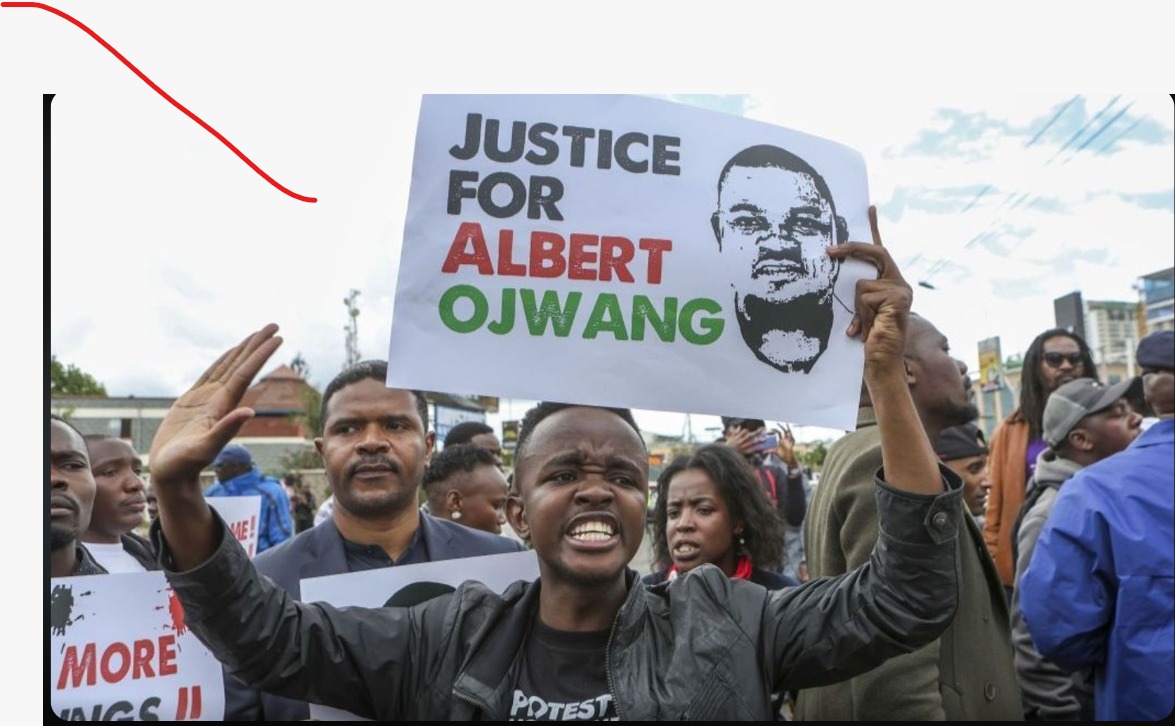
Public confidence in the initial explanation continued to erode as more information emerged. Demonstrations broke out outside Central Police Station, where Ojwang had died, and police responded by dispersing protesters with tear gas. For many citizens, the institution being called upon to explain a death in its custody was now also confronting public outrage over its handling of the incident.
If the death itself raised troubling questions, the handling of evidence raised even more.
According to testimony presented before the Kibera High Court, a digital forensics expert told the court that the CCTV system at Central Police Station had been manually tampered with. When investigators from the Independent Policing Oversight Authority (IPOA) initially sought footage covering June 6 and 7, 2025, the recordings were reportedly unavailable.
Subsequent forensic recovery, however, produced footage showing Albert Ojwang arriving at approximately 9:23 p.m. alive, seated, making phone calls, and appearing calm before being escorted toward the cells where he would spend his final hours.
If the court ultimately concludes that surveillance footage was deliberately deleted, it would suggest an attempt to conceal crucial evidence rather than preserve it. Such allegations, if proven, would represent not merely an administrative failure but a profound breach of public trust in institutions responsible for safeguarding both life and evidence.
Six individuals are currently on trial over Albert Ojwang's death: former station commander Samson Talaam, police constables Peter Kimani and James Mukhwana, together with three civilians who were being held within the same cell block.
The Office of the Director of Public Prosecutions has informed the court that the prosecution's case is that Ojwang's death was not accidental and that the accused persons acted, individually and jointly, in what prosecutors describe as an unlawful enterprise that resulted in his death and was subsequently concealed. Those allegations remain before the court, and the accused are presumed innocent unless and until proven guilty.
Yet even as the trial seeks to establish criminal responsibility, several important questions remain unanswered:
i) Who were the two unidentified men reportedly seen on recovered surveillance footage entering the station alongside an officer shortly before Ojwang's death, and what role, if any, did they play?
ii) Who authorized or facilitated the alleged deletion of CCTV footage? If evidence was deliberately erased, determining responsibility will be critical to understanding whether this was an isolated act or reflected broader institutional failures.
iii) Why was a man arrested in Homabay County over a social media post transported nearly 400 kilometres to Nairobi? What operational or investigative considerations justified that decision?
iv) Why did public demonstrations appear to precede decisive accountability measures? What does this suggest about the responsiveness of internal oversight mechanisms?
v) Beyond those currently before the court, what institutional reforms are necessary to ensure that deaths occurring in police custody are independently investigated, transparently documented, and prevented from recurring?
These questions extend beyond the fate of any individual accused person. They concern the integrity of institutions entrusted with enforcing the law.
Beyond the criminal proceedings themselves, the Albert Ojwang case raises fundamental questions about governance, accountability, and the rule of law in Kenya.
Strong democracies depend on institutions that are transparent, accountable, and willing to subject themselves to independent scrutiny. Digital evidence systems such as CCTV exist not merely to document events but to protect both citizens and law enforcement officers by providing objective records of what occurred. Allegations that such evidence may have been interfered with strike at the heart of public confidence in criminal investigations.
This same case also highlights the indispensable role of oversight institutions such as IPOA, forensic experts, the judiciary, investigative journalists, and civil society organizations. Their combined efforts demonstrate why independent institutions remain essential safeguards against abuse of power.
Ultimately, justice requires more than identifying those who may bear criminal responsibility. It also requires examining whether institutional structures, oversight mechanisms, and accountability systems function effectively enough to prevent similar tragedies in the future.
Albert Ojwang's death has resonated with many Kenyans because it echoes broader concerns about deaths occurring in police custody, enforced disappearances, allegations of excessive use of force, and the protection of constitutional rights. While each case must be judged on its own evidence, collectively they have intensified public debate about police accountability and respect for human rights.
Justice for Albert Ojwang cannot be measured solely by the outcome of one criminal trial. Whatever verdict the court ultimately reaches, Kenyans deserve a full, transparent, and credible account of what occurred inside Central Police Station. Public trust depends not only on fair prosecutions but also on institutions demonstrating that no individual is above the law and that every person in state custody is entitled to dignity, safety, and constitutional protection.
Albert Ojwang made a phone call before he was taken to the cell. Somewhere, someone expected him to return home. He never did.
The measure of a democracy is not how it treats the powerful, but how faithfully it protects the powerless. This case is therefore about more than one man or one police station. It is about whether Kenya's justice system can uncover the truth, uphold the rule of law, and strengthen public confidence in institutions entrusted with protecting every citizen.
Only when the truth is fully established and accountability follows wherever the evidence leads, will justice truly have been served?
This article is based on evidence presented in open court, publicly available forensic findings, and reporting by Kenyan media outlets, including Nation Africa, Citizen Digital, TUKO.co.ke, and Radio47 during the ongoing Kibera High Court proceedings as of July 2026. The criminal trial remains before the court, and all accused persons are presumed innocent unless proven guilty.
Comments
Be respectful and constructive in your comments.